Squint Harder: How Unreadable '90s Liner Notes Turned Us Into Music Detectives
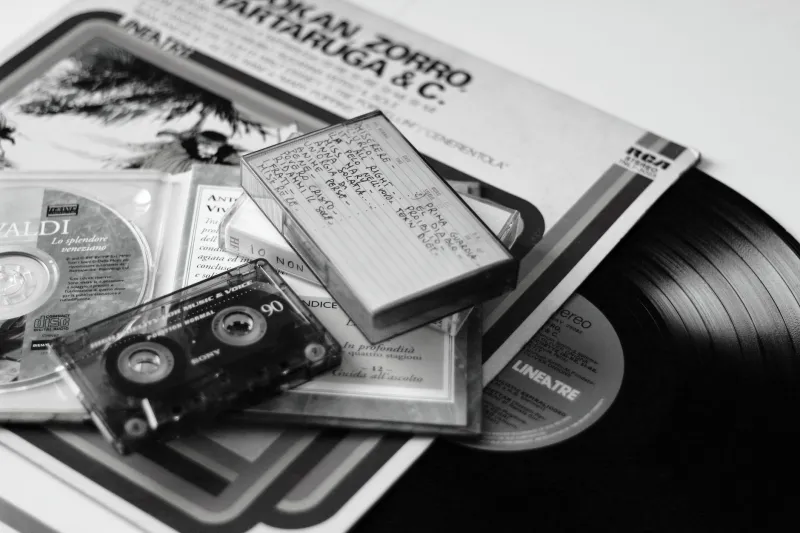
There's a specific kind of frustration that no streaming service will ever be able to recreate. You've got the CD booklet folded open in your lap, the disc is spinning, and you're absolutely convinced that the third name in the 'additional percussion' credit is either 'Mike Harmon' or 'Mike Harman' — or possibly 'Mike Haman' — and it genuinely matters to you. It matters a lot. You've been staring at this for four minutes.
That was the experience. That was the whole thing.
The Handwritten Era Was a Feature, Not a Bug
A lot of '90s artists treated their liner notes like personal notebooks. Scrawled thank-you lists. Lyrics written in that loose, loopy cursive that looked great from a distance and became completely abstract up close. Band members signing their own names in ways that bore almost no resemblance to how those names were actually spelled. It was a mess, and it was everywhere.
But here's what that mess did: it made you a participant. You weren't passively consuming credits — you were decoding them. You were an archaeologist working a very small dig site, and the artifact was a folded piece of glossy paper about the size of a greeting card.
Some bands leaned into it harder than others. Plenty of alternative and indie acts from the era seemed to go out of their way to make their booklets look like they'd been assembled in a van. Smudged ink. Photocopied handwriting that got a little blurrier with each generation. Lyrics that ran off the edge of the page because someone misjudged the margin. It felt authentic in a way that a clean, typeset font simply couldn't fake — and it communicated something important about who these artists were before they even played a note.
The Archaeology of a Thank-You Page
If you were a certain kind of '90s music fan, the thank-you section wasn't something you skimmed. It was something you studied. Who was getting thanked? What did the wording tell you about the relationships involved? Was someone conspicuously absent from the list compared to the last album?
When those names were handwritten, the stakes somehow felt even higher. You'd spend real time trying to parse whether 'shoutout to J' referred to the guitarist's brother or their college roommate or some mysterious industry figure you'd never be able to track down. You'd compare the handwriting across multiple albums from the same band to see if it matched — trying to figure out which member actually wrote the notes versus who just signed off on them.
This wasn't obsessive in a concerning way. It was engaged. It was the kind of deep attention that builds genuine knowledge about something you love. You weren't just a listener — you were a reader, an interpreter, a fan who'd put in the work.
When Wrong Was Still Right
Here's something nobody talks about enough: sometimes you decoded those liner notes incorrectly, and it didn't matter at all. You'd spend weeks convinced a backing vocalist's name was 'Tara' when it was actually 'Tina.' You'd sing along to a lyric you'd misread from the booklet and only find out years later what the line actually said.
And those mistakes became part of your relationship with the record.
There's a psychological concept around the effort we put into acquiring something affecting how much we value it — and it absolutely applied here. The songs you had to work to understand, the credits you had to squint at and cross-reference and occasionally just guess at, became more yours than anything you ever streamed with a clean, algorithmically-generated lyric card floating beneath it.
The friction was the point. The difficulty was the intimacy.
The Ones That Went Full Chaos
Some artists took the illegibility concept to its logical extreme. You'd open a booklet and find lyrics written in multiple directions, overlapping, with doodles cutting through the middle of verses. Production credits listed in a spiral. Band member names written so stylistically that they looked more like logos than words.
A few releases from the era — particularly in the punk, emo, and underground hip-hop spaces — seemed almost adversarial about it. Like the artist was saying: if you want to know this record, you're going to earn it. And fans did. They posted transcriptions on early internet message boards. They argued in forums about what a particular word in a particular credit actually said. They passed physical copies around friend groups specifically so multiple sets of eyes could attempt the translation.
That's a community forming around the act of reading. That's connection built from confusion.
What We Lost When Everything Became Legible
No one is seriously arguing that illegible text is superior to readable text. Clean metadata is genuinely useful. Being able to look up a producer credit in seconds has real value. The era of squinting at photocopied handwriting wasn't without its genuine frustrations.
But something did disappear when music information became instantly, frictionlessly available. The mystery went away. The process of discovery — slow, effortful, occasionally wrong — got replaced by a lookup. And a lookup, however fast and accurate, doesn't build the same relationship with a record that a twenty-minute decoding session does.
The notes nobody could read made us better fans because they demanded something from us. They required attention, patience, and a willingness to sit with uncertainty. They turned passive listening into active investigation.
Next time you pull up an album on a streaming service and the full credits load instantly — every contributor, every session musician, every studio — notice how quickly you scroll past it. Then think about the last time you spent four minutes trying to figure out if a name ended in 'man' or 'mann.'
You remember that name, don't you? Of course you do. You worked for it.