Before They Were Famous, They Were Fuzzy: The Strange Power of '90s Demo Tapes
There's a specific kind of vertigo that comes from hearing a famous song in a form you don't recognize. The vocals are too close to the mic. The drums sound like someone hitting a cardboard box in a hallway. The chorus you've sung a thousand times is slightly off-key, a little slower, and somehow more desperate than you ever remembered it being. That's the demo tape experience—and for a generation of '90s music fans, it was basically a religion.
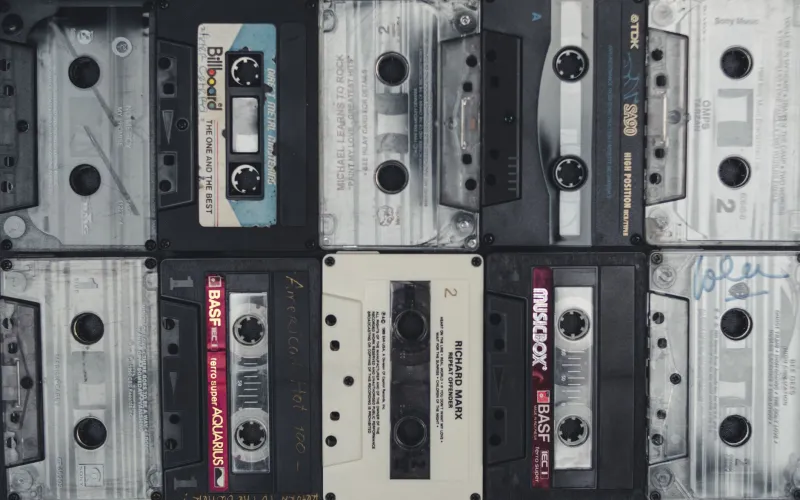
Before the internet made everything instantly available, before leak culture turned unreleased tracks into a 24-hour news cycle, the early recordings of your favorite band existed as objects. Physical things. Cassettes dubbed onto other cassettes, passed hand to hand through networks of fans who communicated via photocopied zines, P.O. boxes, and message boards that loaded one agonizing line at a time. Tracking one down felt like archaeology. And when you finally held it, you treated it accordingly.
The Myth Lives in the Hiss
Here's what nobody talks about enough: the lo-fi quality wasn't a flaw. It was the whole point.
When you heard a polished major-label version of a song, you were hearing a product. Engineers had smoothed every rough edge. The label had approved the mix. Somebody in a suit had signed off on it. But the demo? That was the band before anyone got to them. That was the version that existed when they were just four people in a garage in Seattle, or a basement in Hoboken, or a converted shed outside of Athens, Georgia, trying to figure out if any of this was actually going to work.
The hiss on those tapes wasn't noise. It was proof.
Fans understood this intuitively. A Nirvana demo from 1988 didn't sound like Nevermind because it was recorded two years before Nevermind existed as a concept. A Weezer four-track from the Amherst dorm era sounds nothing like the blue album because Rivers Cuomo hadn't yet been handed a production budget and told to make something radio-friendly. The rawness was the artifact. It told you something about the band's intent before the machine got involved.
How the Underground Actually Worked
If you weren't living it, the mechanics of '90s demo tape trading are genuinely hard to explain to someone who grew up with streaming. It required effort in a way that modern music discovery simply doesn't.
It usually started with a zine—one of those stapled, photocopied newsletters that bands and fans put out themselves, distributed at record stores and shows and through the mail. Zines would list traders: people who had recordings and were willing to dub and swap them. You'd write a letter. An actual letter, with a stamp. You'd include a blank tape and sometimes a self-addressed stamped envelope. Weeks later, if you were lucky, a package would show up with something handwritten on the label in Sharpie.
There were also tape trees, a beautiful pre-internet concept where one person with a rare recording would dub copies for five people, who would each dub copies for five more people, and so on down the line until some kid in rural Ohio had a fourth-generation copy that sounded like it was recorded through a pillow. He didn't care. He had it.
Record stores played a role too. The good ones—the independently owned spots with the bins of used cassettes and the employees who actually knew things—often had informal networks of their own. If you were a regular and you mentioned you were looking for something specific, sometimes something would materialize a few weeks later. No explanation. Just a tape on the counter with your name on a Post-it.
What You Actually Hear When You Finally Find It
Here's the thing about finally tracking down a demo you've been chasing for twenty-five years: it almost never sounds the way you imagined it would.
The mythology had time to build. You'd read descriptions of the recording in interviews, seen blurry photographs of the session, maybe heard someone describe a specific moment in the song that didn't make it to the album version. In your head, the demo became something almost sacred—the Platonic ideal of the band before the world changed them.
Then you actually hear it, and it's weirder and messier and more interesting than the legend. The guitar part you expected isn't there yet. The lyrics are different in the second verse. The singer sounds younger, not because they were performing youth but because they actually were young and hadn't yet figured out how to control what they were doing. It sounds like a person, not a persona.
That's the ghost-encounter feeling. You're not hearing the artist you grew up with. You're hearing whoever they were before they became that artist. It's disorienting and oddly moving in equal measure.
When the Internet Blew the Vault Open
The digital era changed demo culture permanently, and the feelings about that shift are genuinely complicated.
On one hand, recordings that spent decades circulating on degraded cassettes are now archived in decent quality, accessible to anyone with a search engine and a little patience. The Smashing Pumpkins' early four-tracks, Tupac's pre-2Pacalypse Now recordings, the Elliott Smith home tapes that circulated among Portland fans before Roman Candle even existed—this stuff is findable now in a way it simply wasn't before.
On the other hand, something got lost in the translation. Part of what made a demo feel significant was the effort required to obtain it. The scarcity wasn't just a logistical inconvenience; it was a filter. The people who had those tapes really wanted them. They'd worked for them. That shared effort created a kind of community, a sense that you were part of something smaller and more intentional than a general audience.
When everything is available to everyone, nothing feels rare. And rare was kind of the whole point.
Why It Still Matters
For a generation of fans who came of age in the '90s, demo tapes represented something that streaming has never quite replaced: the feeling of knowing a band before the world knew them. Or knowing a version of them that the world never got to hear.
There's a reason people still seek out bootlegs and early recordings even now, when the polished versions are a tap away. It's not audiophile obsession or completionist hoarding, though sometimes it looks like those things from the outside. It's something closer to intimacy. The demo says: this is what it sounded like before anyone was listening. And that, for a lot of fans, is the most honest thing a recording can be.
The hiss, the clipped vocals, the tempo that drifts slightly in the chorus—none of that is a problem to fix. It's a timestamp. It's proof that the music existed before it was famous, in a room somewhere, with nobody paying attention yet.
That's the version some of us have been chasing all along.