Thirteen Songs and a Sharpie: Why Your Mix CD Knew You Better Than Spotify Ever Will
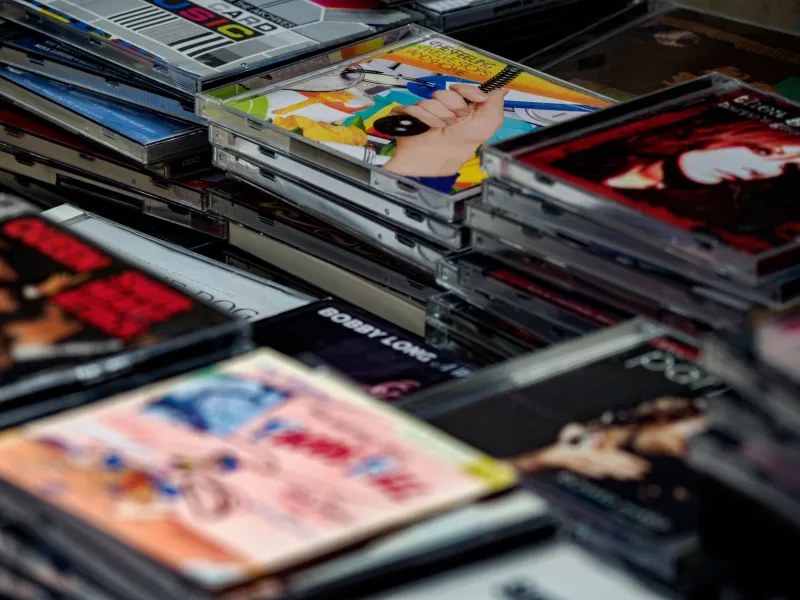
Somewhere in a closet, a shoebox, or the back seat pocket of a car that's long since been junked, there's a CD with your handwriting on it. Maybe it just says Road Trip '99 in blue Sharpie. Maybe you went full art project — bubble letters, song titles listed in order, little stars next to the ones that mattered most. Either way, you remember making it. You remember exactly why you put those songs in that order.
That's not something any algorithm has ever been able to replicate.
The Ritual Before the Road
Making a mix CD in the '90s was not a casual act. You didn't open an app and drag a few tracks into a queue. You sat at a desktop computer — or, if you were still living in the early part of the decade, at a dual-cassette deck — and you made decisions. Real, deliberate, sometimes agonizing decisions.
How do you follow "Waterfalls" without killing the energy? Do you put the slow song third or save it for the end? Is it weird to open with something too intense? These were actual questions people sat with. The 74-minute limit on a standard CD-R wasn't a bug — it was the whole game. You had a finite canvas, and everything you chose to put on it said something about you.
Jamie Kowalski, 38, from Columbus, Ohio, still has a binder of mix CDs she made between 1997 and 2003. She pulls it out maybe once a year, she says, usually when she's moving apartments or cleaning out a closet.
"Every single one of those discs is basically a journal entry," she told us. "I don't need to remember what was happening in the fall of 2001. I just have to look at what I put on that CD and I know exactly where I was emotionally."
She's not wrong. The mix CD was documentary evidence of a feeling. And because burning it took actual time and effort, you didn't make one unless the moment deserved it.
Why the Limit Made It Matter
There's a psychological concept called the paradox of choice — the idea that having too many options actually makes people less satisfied with whatever they end up picking. Streaming services have essentially turned music consumption into an infinite buffet, which sounds amazing until you realize you've spent twenty minutes scrolling and still haven't decided what to listen to.
The mix CD solved that problem by force. You picked your songs, you burned them, and that was it. No skipping to a different playlist. No "up next" queue quietly reshaping your mood without your permission. You committed.
And because you committed, you listened differently. When you only have thirteen or fourteen tracks to work with, you actually hear all of them. You notice the way one song bleeds into the next. You start to understand why sequencing matters — why putting Alanis Morissette right after a Boyz II Men slow jam either works brilliantly or completely falls apart.
Dave Chen, 41, a music teacher in Austin, Texas, says that making mix CDs as a teenager was basically his first music education.
"I learned more about song structure and emotional dynamics from putting together mixes than I ever did from any class," he said. "You figure out pretty fast that a great song in the wrong spot ruins the whole thing. That's a real skill. I use it when I'm teaching kids now and I have to explain why a setlist matters."
The Social Currency of the Handoff
The mix CD was also, let's be honest, one of the most loaded social gestures of the era. Giving someone a mix was a whole statement. It could mean I like you and I want you to know what's living inside my head right now. It could mean I'm sorry, and I didn't know how else to say it. It could mean we're best friends and this is proof.
Receiving one meant you had to listen to it. All of it. Because the person who made it was going to ask you about it, and you needed to have feelings ready.
There was no "oh I'll check it out sometime" with a mix CD. It was a physical object sitting in your car, and eventually the CD player was going to eat it and you were going to have to deal with whatever was on track seven.
That forced exposure is something streaming has quietly killed. Today you can send someone a Spotify playlist link and they might listen to two songs before the algorithm pulls them somewhere else entirely. The maker's intent evaporates. The sequencing becomes irrelevant. The whole thing loses its shape.
Songs You Wouldn't Have Found Any Other Way
One of the stranger gifts of the mix CD era was accidental discovery. You'd get a disc from a friend, and somewhere between the TLC track you already knew and the Matchbox Twenty song that was inescapable that year, there'd be something you'd never heard before. Something that became yours.
Streaming discovery is algorithmic. It's based on what you already like, fed back to you in slightly different configurations. Mix CD discovery was human. It was someone else saying this one matters, trust me — and because they'd burned it onto a physical disc and handed it to you, you did.
Kowalski remembers getting a mix from a college roommate in 1999 that introduced her to Fiona Apple, Massive Attack, and a deep cut from the Miseducation of Lauryn Hill she'd somehow missed.
"That disc genuinely changed what I listened to for years," she said. "There's no way an algorithm would have connected all three of those for me. It took a person who knew me."
What We Actually Lost
This isn't a piece about how streaming is bad. It's more complicated than that. Streaming gave us access to basically everything, and that's genuinely remarkable. But access isn't the same as attention, and volume isn't the same as meaning.
The mix CD forced you to be intentional — about what you chose, about why you chose it, about who you were making it for. It made you a curator before that word became a LinkedIn buzzword. And it created a record, a physical artifact of a moment in your life, that no playlist URL is ever going to match.
If you still have yours somewhere, go find them. Put one in an old player if you can track one down, or just read the track listing in your own handwriting from twenty-five years ago. You'll remember exactly who you were when you made it.
And you'll probably remember why you put that one song right there in the middle — the one that was doing all the emotional heavy lifting — where nobody could skip past it.