Before Spotify Had Playlists, Soundtracks Were Doing It Better
There's a specific kind of memory that belongs exclusively to the '90s: standing in a record store, staring at a soundtrack album, trying to decide if you actually needed it even though you'd already seen the movie twice. You probably bought it. And you were absolutely right to.
The '90s movie soundtrack wasn't a promotional afterthought. It was a full creative statement — sometimes more coherent, more emotionally layered, and more culturally durable than the film it was supposed to be supporting. Decades later, people still throw on the Trainspotting soundtrack on a Friday night. Fewer people are rewatching Trainspotting on a Friday night. That gap tells you everything.
The Soundtrack as Its Own Art Form
What made the '90s so fertile for this stuff was timing. The compact disc was in its commercial prime, music supervision was becoming a recognized craft, and directors were increasingly treating the soundtrack as a storytelling tool rather than background noise. At the same time, the music industry was fat with cash and willing to let interesting things happen.
The result was a run of compilations that functioned less like movie tie-ins and more like albums with a loose conceptual spine. The Pulp Fiction soundtrack — released in 1994 — is probably the cleanest example. Quentin Tarantino essentially made a mixtape and called it a movie score. Dick Dale's surf guitar sitting next to Urge Overkill covering Neil Diamond sitting next to Al Green. It made no logical sense and it was completely perfect. People bought that record who had never once thought about surf music before in their lives.
The Clueless soundtrack did something similar for a younger audience. It introduced suburban teenagers to Coolio, Supergrass, and The Mighty Mighty Bosstones in one sitting and framed all of it as aspirationally cool. You weren't just buying music — you were buying into an identity. That's a harder trick to pull off than it sounds.
When the Soundtrack Was Darker Than the Film
Not every great '90s soundtrack belonged to a great '90s film, and that's part of what makes this era so interesting. The Crow, released in 1994, is a genuinely good movie, but its soundtrack — featuring Nine Inch Nails, Stone Temple Pilots, Rage Against the Machine, and Pantera, among others — operated on a completely different level. It was one of the defining documents of early '90s hard rock and metal, assembled with a curatorial precision that felt almost accidental given how chaotic the genre landscape was at the time.
Kids who bought that record weren't necessarily fans of the film's gothic aesthetic. They were fans of the music, and the film gave them a convenient package to find it all in. The soundtrack was doing discovery work that radio couldn't do and the internet didn't exist to do yet.
Same goes for Singles, Cameron Crowe's 1992 love letter to Seattle. The film is a perfectly fine romantic comedy. The soundtrack — featuring Pearl Jam, Soundgarden, Alice in Chains, and Mudhoney — is a time capsule of grunge at its exact commercial peak. It captured something that felt alive and specific to a moment, and it did it before most of the country had even heard of any of those bands.
The Ritual of the Physical Object
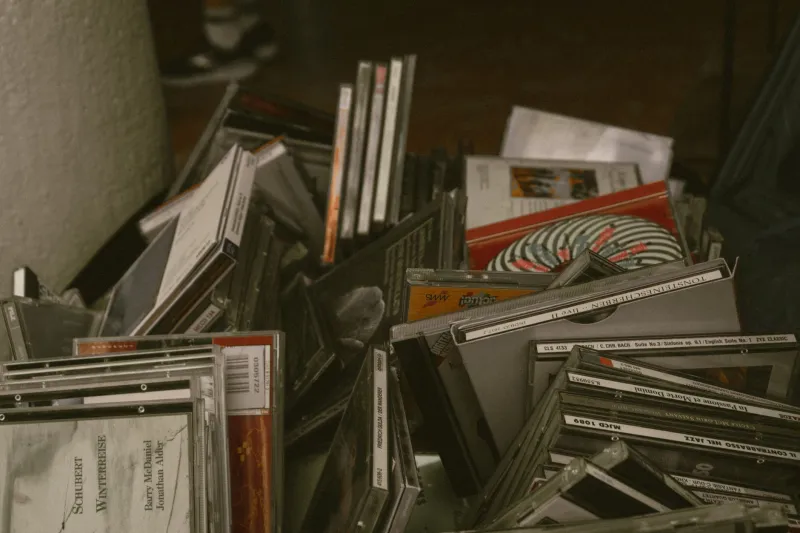
Part of why these soundtracks hit so hard was the object itself. The CD booklet was real estate. Liner notes, credits, photos, lyrics — all of it mattered. When you bought the Trainspotting soundtrack and cracked it open, you got Irvine Welsh's track-by-track annotations. That's not liner notes, that's editorial content. That's a relationship between the music and the words that made the listening experience richer before you'd even pressed play.
There was also the sequence. The running order on a great '90s soundtrack was deliberate — it built tension, shifted moods, created transitions that made you feel like someone had thought carefully about how this should feel from start to finish. Iggy Pop's "Lust for Life" opening Trainspotting is one of the great first-track choices in music history. Underworld closing it out with "Born Slippy .NUMTWO" is one of the great final-track choices. That's not an accident. That's craftsmanship.
Streaming playlists don't have that. They have suggestions. There's a difference.
Why the Algorithm Can't Replicate This
Modern music supervision is still alive — there are some genuinely excellent soundtrack choices happening in prestige TV and film right now. But the cultural weight of the '90s standalone soundtrack album is essentially unreproducible in a streaming environment.
When everything is available all the time, the act of curation loses its scarcity value. Part of what made finding Leftfield on the Trainspotting soundtrack so exciting was that you might not have found Leftfield any other way. The soundtrack was a door into rooms you didn't know existed. Spotify's algorithm opens doors too, but it opens them based on what you already like. That's a fundamentally different experience.
The '90s soundtrack introduced you to things you didn't know you were going to love. It trusted you to follow it somewhere unfamiliar. That's not a feature modern streaming platforms are particularly interested in building.
The Ones That Still Hold Up
Ask anyone who was a teenager in the '90s to name a soundtrack that still lives in their regular rotation and you'll get a short list that repeats itself constantly: Pulp Fiction, Clueless, The Crow, Trainspotting, Singles, Romeo + Juliet (the Baz Luhrmann one with the Garbage and the Everclear and Des'ree), Good Will Hunting, Jackie Brown. These aren't nostalgia plays. These are genuinely good records that happen to have movie titles on the cover.
The '90s didn't invent the movie soundtrack, obviously. But it perfected a specific version of it — the curated compilation that doubled as cultural document, identity signal, and discovery engine all at once. No algorithm has matched that yet. Honestly, it's not clear one ever will.