Scissors, Glue, and a Dream: How the '90s Bedroom Wall Was Already Doing What Pinterest Promised
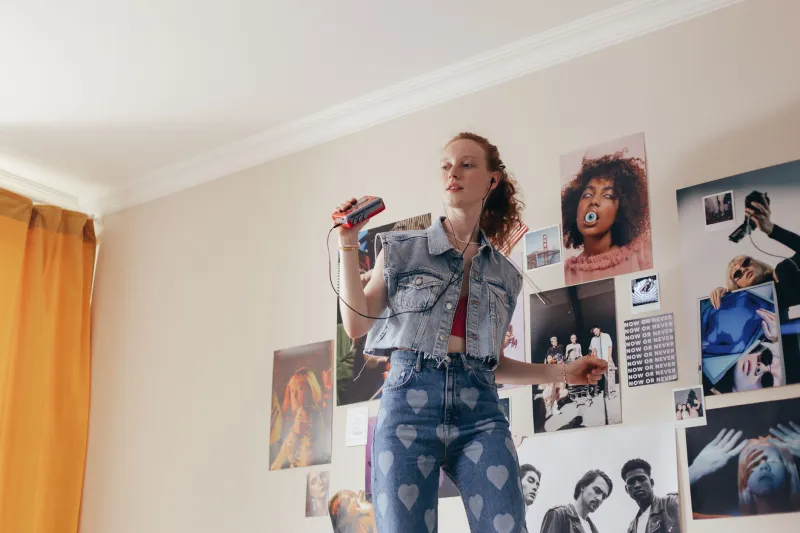
Somewhere in a storage unit or a parent's attic, there's probably a box of old Teen People and Seventeen magazines with half their pages missing. Ripped out carefully — or not so carefully — and repurposed for something that felt way more important than reading an article. Those pages ended up on bedroom walls across America, layered and overlapping, forming something personal and chaotic and entirely yours.
Nobody called it a vision board back then. That language hadn't really trickled down into everyday conversation yet. But that's exactly what it was. And if you grew up in the '90s, there's a decent chance your wall was doing more psychological heavy lifting than you ever gave it credit for.
The Wall as a Mirror — and a Map
There's a reason teenagers didn't just stack their magazines in a pile and leave it at that. Cutting something out and physically placing it somewhere — choosing where it goes, what it goes next to, how much space it gets — is an act of intention. You were making decisions about what mattered to you every single time you rearranged that corner of your room.
Psychologists who study identity formation talk about the importance of externalizing your inner world during adolescence. It sounds clinical, but it basically means: you need to see yourself reflected somewhere outside your own head. For '90s teenagers, the bedroom wall was that mirror. It showed you back to yourself. This is who I am. This is who I want to be. This is what I think is cool.
A photo of Aaliyah. A Dazed & Confused movie still. A ticket stub from a local show you barely remember. A quote torn from a Rolling Stone interview. None of it was random, even when it looked like it was.
Why Physical Curation Hits Different
Here's the thing that gets lost in the scroll: when you build something with your hands, your brain treats it differently. There's actual research behind this — sometimes called the "IKEA effect" — where people assign more value to things they've personally assembled or created. Your wall wasn't a feed you could refresh. It was a construction project. You had to commit.
You felt the paper. You got glue on your fingers. You stepped back and looked at it from across the room and decided whether that Braveheart poster clashed too hard with the Spice Girls spread next to it. (It did. You kept both anyway.) Every addition was a physical act, and physical acts stick in memory in a way that clicking a "save" button never quite replicates.
Digital vision boards aren't useless — but there's something about the frictionlessness of Pinterest that makes it easy to pin five hundred things without any of them meaning much. The '90s wall had natural limits. You ran out of wall space. You ran out of good magazines. You had to choose.
The Magazines Were the Algorithm
It's worth pausing on where the raw material came from. Vibe, Spin, YM, Entertainment Weekly, Source — these publications were the curators. They decided what got photographed, who got cover placement, which artists were worth two full pages versus a quarter column. When you cut something out and put it on your wall, you were working within a system, same as any algorithm today.
But here's the difference: you had to physically encounter every page to find what you wanted. You couldn't search. You couldn't filter by aesthetic. You had to browse, which meant you stumbled across things you weren't looking for. That random discovery — finding a photo of some band you'd never heard of and thinking wait, who is this — was baked into the format. Serendipity was part of the deal.
That's something the current digital experience has largely engineered out. Recommendation engines are good at showing you more of what you already like. They're not particularly great at showing you something that genuinely surprises you.
Goals Without the Cringe
Modern vision board culture can get a little intense. Manifestation language, abundance mindsets, the whole thing. '90s bedroom walls were doing the same conceptual work without any of the self-help vocabulary attached to it.
You put up a photo of a recording studio because you wanted to make music someday. You taped up a map of a city you'd never been to because you were going to live there eventually. You kept a picture of someone whose style you wanted to absorb. None of this required journaling about your intentions or writing affirmations in a specific color of ink. It was just there, in your peripheral vision, every single day when you woke up and every night before you fell asleep.
That kind of low-key, ambient goal-setting is actually pretty effective. Seeing something repeatedly — without pressure, without a formal practice around it — normalizes it as a possibility. Your brain starts treating it as achievable rather than abstract.
Gen Z Is Putting It Back on the Wall
Ask around, and you'll find a growing number of younger people who are deliberately going analog with this stuff. Buying physical magazines. Printing photos from their phones. Hitting up thrift stores for old issues of publications they've never actually read, just because the photography is better than anything they can screenshot.
There's a tactile hunger underneath it. A desire to make something that exists in the room with you rather than inside a device. Social media has made the bedroom wall public again — people photograph their collages and post them — but the act of building the thing is still private. Still physical. Still yours in a way that a saved folder never quite is.
The '90s didn't invent the idea of surrounding yourself with images that inspired you. People have been doing that forever. But there was something about that particular decade — the magazine culture, the poster economy, the sheer amount of visual content that existed only in print — that made bedroom walls into a genuinely rich medium for self-expression.
The Wall Knew Before You Did
Look back at old photos of your teenage bedroom, if you have them, and you might be surprised by what you were telling yourself. The patterns are usually pretty clear in retrospect. The things you kept coming back to, the images you put at eye level versus the ones you stuck in a corner — all of it was a map of something.
Pinterest is fine. Digital mood boards have their place. But there's a reason people keep coming back to the physical version, keep tearing pages out of magazines, keep reaching for the thumbtacks. Some things work better when they take up actual space in the world.
Your wall knew what you wanted long before you had the language to say it out loud. That's not a small thing.