Five Notes and You Knew Exactly Where You Were: The Death of the 92 FM Jingle
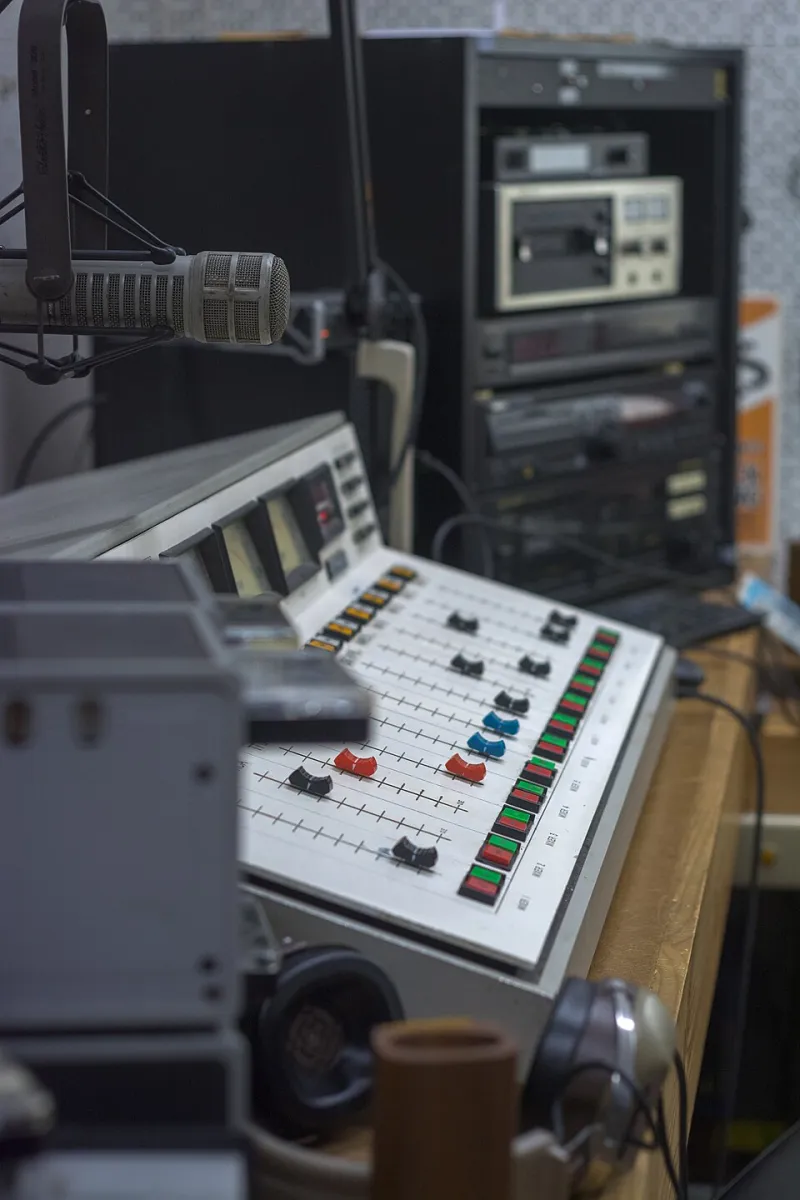
Photo: Ethan Long, CC BY-SA 2.0, via Wikimedia Commons
Close your eyes for a second. Think about your local 92 FM station — the one you grew up with, the one your parents had on during road trips, the one that felt like it was broadcasting specifically for your neighborhood. Now try to hear it. Not a song. Not a DJ's voice. The station itself.
If you're of a certain age, something probably just played in your head. A quick melodic phrase. Maybe a vocalist singing the station's call letters in a key that felt weirdly triumphant. Maybe a sweeping synth riff that dissolved into the next song. That's a jingle. And if you can still hear yours, you already understand why their disappearance from American radio is such a quietly devastating loss.
The Architecture of a Three-Second Miracle
Jingles weren't accidents. They were engineered with a precision that bordered on obsessive. The production houses that specialized in radio IDs — companies like PAMS Productions out of Dallas, TM Studios, and later Groove Addicts — understood something that modern marketing still struggles to articulate: sonic branding works on a level that visual branding simply can't reach.
"You could close your eyes and know exactly which station you were on," says Gary Tolliver, a former program director who worked at several 92 FM-adjacent stations throughout the '80s and '90s. "That was the whole point. You didn't need a logo. You needed five notes."
The best jingles accomplished several things simultaneously. They stated the station's identity. They set an emotional tone. They bridged the gap between whatever just played and whatever was coming next. And they did all of this in under ten seconds. As an exercise in communication efficiency, it's genuinely remarkable.
For 92 FM stations specifically, the jingle had to thread a needle. The number 92 is inherently musical — two syllables, easy to sing, punchy. "92 FM" became a phrase that dozens of different stations across the country turned into dozens of different sonic signatures, each one tuned to its local market's personality.
Dallas Had One. So Did Detroit. So Did Denver.
Part of what made the golden era of 92 FM jingles so rich was the regional specificity. A jingle produced for a country-leaning 92 in Nashville sounded nothing like one produced for a hip-hop-forward 92 in Miami. The melody might share DNA — PAMS sold packages that multiple stations licensed — but the arrangement, the vocal style, and the production choices reflected the local culture.
In Houston, listeners who remember KQUE from the late '70s still describe its station IDs with a kind of reverence. "It was this warm, almost gospel-inflected thing," recalls Denise Carver, who grew up in the Third Ward and now runs a music education nonprofit. "When you heard it, you knew you were home. That sounds dramatic, but that's genuinely how it felt."
That emotional anchor is not an accident of nostalgia. Research conducted by audio branding firms in the early 2000s — ironically, right around the time jingles were disappearing — confirmed what radio producers had known intuitively for decades: consistent sonic branding creates measurable listener loyalty. People don't just recognize a sound; they bond with it.
The Consolidation That Silenced the Singers
So what happened? The short answer is money. The longer answer is the Telecommunications Act of 1996.
Before deregulation, radio station ownership was capped in ways that kept the industry relatively local. A company could only own so many stations in a given market, which meant that individual stations had to compete for local listeners and, therefore, had strong incentives to develop distinct local identities. Jingles were part of that identity-building toolkit.
After 1996, consolidation happened fast. Large radio groups like Clear Channel (later iHeartMedia) and Cumulus Media began buying up stations in bulk. The economic logic of running a radio network meant standardizing everything that could be standardized — including, eventually, the sounds between the songs.
"When a company owns forty stations, they're not commissioning forty different jingle packages," explains Randy Marsh, a jingle composer who worked steadily through the '80s and watched his industry contract sharply in the early 2000s. "They might commission one. Or they might just use a generic imaging package and slap different call letters on it. The local flavor goes away because local flavor costs money."
The irony is that what felt like a cost-saving measure may have accelerated listener drift. As stations started sounding more generic, listeners had less reason to feel loyalty to a specific station over a streaming playlist. The jingle wasn't just a branding tool — it was a relationship. Kill the jingle, and you start killing the relationship.
What Streaming Still Can't Do
Spotify can recommend you a song based on your listening history with uncanny accuracy. Apple Music can build you a playlist that feels almost telepathically curated. What neither of them can do is make you feel like you belong to something.
That's the thing about a great 92 FM jingle. It wasn't just telling you what station you were on. It was telling you that you were part of a community — that the person driving next to you on the highway, and the family eating dinner three blocks over, and the teenager doing homework in the suburbs were all hearing the same five notes at the same moment. Shared experience, delivered in real time.
"Streaming is incredible for music discovery," says Tolliver. "But it's a solitary experience. Radio, at its best, was communal. And those jingles were the handshake that said, 'Yeah, you're in the right place.'"
A handful of stations have tried to bring jingles back in recent years, usually as a retro novelty or a heritage-brand play. And listeners respond — sometimes with genuine emotion that surprises even the stations themselves. People call in. People post about it. People remember.
Maybe that's the real story here. The jingles are gone, but the need they filled isn't. Somewhere between the algorithm and the autoplay, there's still a part of the American listener that wants to hear five notes and know exactly where they are.
We just haven't found the modern version of that sound yet.