Born Too Late, Arrived Right on Time: Why Gen Z Can't Stop Living in the '90s
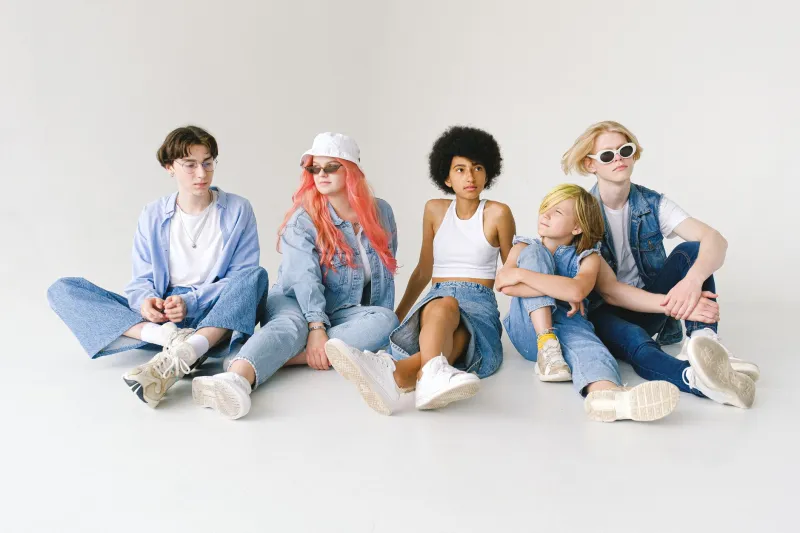
There's a teenager somewhere right now wearing a baby tee with a faded band logo, listening to TLC through wireless earbuds, filming a thrift haul for TikTok. She was born in 2007. She has never seen a phone with a cord attached to a wall. She has absolutely no memory of Y2K panic or Must See TV Thursday nights. And she is, without question, deeply, sincerely obsessed with the 1990s.
This isn't a small trend. It's not a quirky corner of the internet. Gen Z's fixation on '90s culture has become one of the defining aesthetic movements of the early 2020s — and it keeps picking up speed instead of fading out. The question worth asking isn't just why they love it. It's what kind of love this actually is, and whether it counts as nostalgia at all when you weren't there to begin with.
The Algorithm Handed Them a Decade
Streaming and social media didn't just make '90s content available to younger generations — they made it inescapable. Spotify's recommendation engine doesn't care that you were born after Jagged Little Pill dropped. If the data says you'll listen, it'll serve it. TikTok's For You Page has no concept of chronology whatsoever. A 30-second clip of Destiny's Child lands the same way whether you're 38 or 17.
What's different for Gen Z is that they encountered the '90s fully formed, all at once, without the slow build of actually living through it. They didn't wait for a new Nirvana album. They got the entire catalog on day one. They didn't watch Friends week to week — they binged it in a long weekend. The decade arrived in their lives not as a series of moments but as a complete aesthetic package, already curated, already iconic, already drenched in the warm glow of retrospect.
That changes the relationship. For people who actually lived through the '90s, the decade is tangled up with specific memories — a middle school hallway, a specific summer, a relationship that ended badly. For Gen Z, the '90s is more like a mood board. It's a vibe they can step into and out of, remix and reinterpret, without any of the emotional baggage attached.
Nostalgia Without the Memory
There's a term some researchers have started using for this: anemoia — a longing for a time you've never actually experienced. It's different from classic nostalgia, which is rooted in personal memory. Anemoia is more about the idea of a time, the aesthetic suggestion of it, the way old photos and filtered footage make a past era feel warm and safe even if you weren't there.
The '90s, as Gen Z encounters them, are almost perfectly engineered to trigger that feeling. The era has enough distance to feel genuinely retro — those platform sneakers and slip dresses and chunky highlights read as vintage now, not just old. But it's not so distant that it feels alien or inaccessible. The '90s had the internet, just barely. It had pop music that still sounds catchy. It had TV shows that are still watchable. It's close enough to feel familiar, far enough to feel like somewhere else.
Compare that to, say, the 1970s or 1950s, which younger generations tend to engage with more ironically or academically. The '90s hit different because the gap is just right. It's the decade that raised their parents, which means it shows up in their homes, their family photos, the music their moms played in the car. It's inherited culture, not discovered culture — and that gives it a warmth that purely historical eras can't quite replicate.
TikTok Turned the '90s Into a Costume — and That's Not an Insult
A lot of older millennials and Gen X folks get a little defensive when they see younger people adopting '90s aesthetics. There's a real "you had to be there" energy that creeps into the conversation. And fair enough — watching someone film a "'90s aesthetic" video using a vintage-filter app, while wearing a crop top they bought new from Urban Outfitters, can feel a little hollow if you actually remember the decade.
But here's the thing: every generation does this with the era before them. Millennials romanticized the '60s and '70s without living through Vietnam or Watergate. Gen X had a whole thing with '50s diner culture that had nothing to do with actual postwar America. Adopting the aesthetic of a past era while leaving behind the harder parts of it is basically how pop culture has always worked.
What's genuinely new is the speed and scale at which Gen Z can do it. A single TikTok sound — say, a snippet of Brandy or a riff from a '90s R&B deep cut — can reach millions of teenagers in 48 hours. Fashion trends that would have taken years to cycle back around are now resurrected in weeks. The decade isn't being slowly rediscovered; it's being instantly remixed, constantly.
What the '90s Offers That Right Now Doesn't
There's also something worth saying about why the '90s specifically, rather than the 2000s or 2010s. Part of it is timing — the 2000s are just now reaching peak nostalgia distance, and the 2010s are too recent to feel retro yet. But part of it is something more specific to what the '90s represented.
The decade has come to stand for a certain kind of uncomplicated confidence. Pre-social media. Pre-constant connectivity. Pre-everything-being-documented-and-judged. For a generation that has grown up with their entire lives online, the idea of a world where you could just exist without your existence being performed and measured — that's genuinely appealing. The '90s didn't have comment sections. Nobody was canceling anyone on Twitter in 1995.
That's a fantasy, obviously. The '90s had plenty of its own anxieties and injustices. But the idea of the '90s — the aestheticized, filtered, TikTok version of it — offers Gen Z something their actual present doesn't: the illusion of a simpler signal, a life less cluttered by noise.
A Love Letter to Somewhere They've Never Been
Maybe the most honest way to understand Gen Z's '90s obsession is to stop measuring it against how people who actually lived through the decade feel about it. It's not the same thing. It was never going to be. They're not trying to remember the '90s — they're using the '90s as raw material to build something that speaks to where they are right now.
And honestly? That's what every great era of music and culture has always done. The '90s itself borrowed heavily from the '70s. Hip-hop was built on samples. Grunge was indebted to punk. Nothing starts from scratch. Gen Z picking up the '90s and running with it isn't a theft — it's a continuation.
The decade never really ended. It just found a new audience. And that audience is making it louder than ever.