Judge a Record by Its Cover: The Beautiful Recklessness of Buying Blind in the '90s
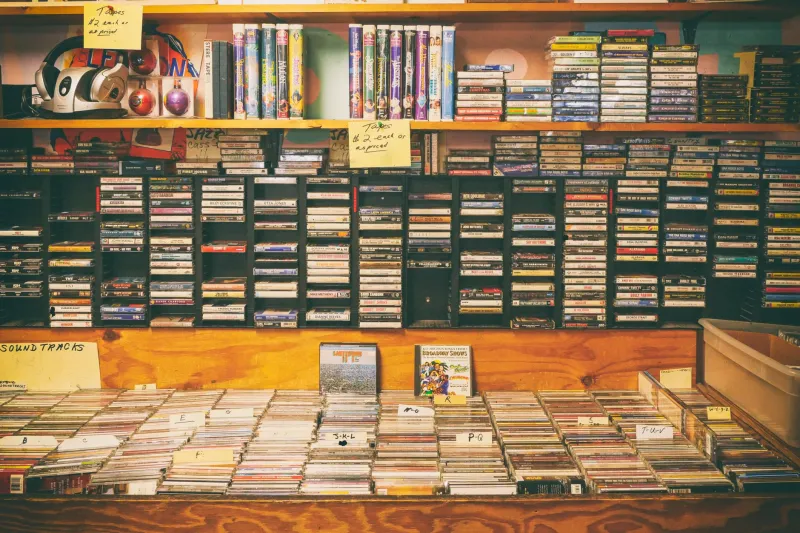
Somewhere in a suburban mall in 1994, a teenager is standing in the new releases section of a record store, holding a CD they've never heard a single second of. The cover is striking — weird, maybe, or beautiful in a way that's hard to articulate. The band name means nothing. There are no streaming previews. No YouTube videos to pull up. No algorithm saying "fans of this also liked..."
They buy it anyway.
This happened millions of times across the United States every single week during the decade when physical music retail was at its absolute peak. And the culture it created — the passionate, almost irrational fandom that grew out of blind purchases and accidental discoveries — is something the current music landscape has largely traded away in exchange for convenience.
The Record Store as a Decision Environment
To understand what made '90s album art so powerful, you have to understand what it was competing with. A well-stocked record store in the mid-'90s was an overwhelming physical space. Thousands of titles. Listening stations for maybe a dozen albums, if you were lucky. Staff picks hand-written on index cards. Word of mouth from whoever happened to be working that day.
In that environment, visual identity wasn't just branding — it was communication. Album art had to do real work. It had to signal genre, mood, attitude, and artistic intent in a single image, because that image might be the only thing standing between a sale and a pass.
This created an era of genuinely adventurous cover design. Labels and artists understood that weird, striking, or visually arresting covers moved product in a way that safe, polished imagery often didn't. Think about the stark, unsettling simplicity of Portishead's Dummy. The raw, confrontational close-up on PJ Harvey's Dry. The abstract, almost painterly quality of early Weezer promotional photography. These weren't accidents. They were calculated bets on the idea that a certain kind of listener would respond to a certain kind of visual signal.
The Gamble and What It Built
Here's what nobody talks about enough when they discuss '90s music culture: the financial stakes of a blind purchase were real. A new CD cost somewhere between $13 and $17 at most retail chains. For a high schooler working a part-time job, that was a meaningful chunk of disposable income. You didn't spend it carelessly.
Which means when you made the leap — when you bought something based purely on a cover, a band name, or a vague recommendation — you were invested before you even got home. You'd committed real resources to this album. You were going to listen to it seriously. You were going to give it every possible chance to justify the decision.
This forced listening created a kind of patience that streaming has almost entirely eliminated. If an album didn't immediately connect, you didn't just skip to the next recommended title. You went back. You tried again from a different track. You lived with it for a week because you'd already spent the money and you wanted to understand what you'd bought.
Some of the most beloved albums of the decade — records that have built multigenerational audiences and genuine cult followings — are records that required exactly this kind of patient attention. They didn't reveal themselves immediately. They opened up slowly, over repeated listens, rewarding the kind of investment that only happens when you can't just tap "next."
The Visual Vocabulary of '90s Album Art
Certain visual languages became reliable signals for certain kinds of music in the '90s, and fans learned to read them fluently. Blurry, oversaturated photography on a thin cardboard sleeve meant indie rock, probably from a small label, probably worth investigating. Heavy gothic typography with industrial imagery pointed toward a specific corner of the alternative scene. Clean, almost clinical design suggested post-punk influences or art-rock ambitions.
Band names operated the same way. Nobody knew what Smashing Pumpkins sounded like before they heard them — but the name itself communicated something. Same with Massive Attack. Same with Garbage. Same with Built to Spill. These weren't random word combinations. They were carefully chosen to attract a specific listener and repel the wrong one.
This was a kind of pre-filtering that worked entirely on vibes and intuition, and it was surprisingly effective. The people who bought Bjork's Post because the cover looked unlike anything else in the store were, by self-selection, probably the exact people who were going to love Bjork's Post.
What Algorithmic Recommendations Can't Replicate
Modern music discovery is extraordinarily efficient. Spotify's recommendation engine is genuinely impressive at surfacing music you're likely to enjoy based on your listening history. Apple Music's editorial playlists are thoughtfully curated. YouTube's autoplay rarely takes you somewhere completely unexpected.
But efficiency and discovery are not the same thing. True discovery — the kind that reshapes your taste and expands your sense of what music can be — requires surprise. It requires the possibility of being wrong. It requires the risk of spending money on something that might not work out, because that risk is what makes the payoff feel meaningful.
Algorithmic recommendations are, almost by definition, conservative. They work by identifying patterns in what you've already liked and extending those patterns forward. They're very good at giving you more of what you want. They're structurally limited in their ability to give you something you didn't know you wanted.
The kid standing in the record store in 1994, holding an album they've never heard, operating on nothing but visual instinct and a gut feeling — they're doing something the algorithm genuinely cannot do. They're making a leap.
The Cover That Changed Everything
Ask almost any passionate music fan who came of age in the '90s about their most important musical discovery, and there's a reasonable chance it starts with a cover. Not a recommendation. Not a playlist. Not a curated "you might also like." A physical object, sitting in a bin, catching the light in a specific way on a specific afternoon — and a split-second decision to take a chance on it.
That's not a romantic myth. That's how a generation of music fans actually got built. One blind purchase at a time.